

The River Changed but Pagosa Didn’t Wash Away.
"A complete and in-depth river update on the historic 2025 San Juan River floods, recovery work, and the next chapter of river restoration in Pagosa Springs”
For a few days in October 2025, the San Juan River became the biggest story in Pagosa Springs.
Not the hot springs. Not fall colors. Not road construction. Not the usual small-town swirl of meetings, visitors, fishing reports, river rumors, coffee-shop analysis, and “did you see what the water’s doing?” conversations.
Just the river.

It rose fast, loud, brown, and powerful. It climbed out of its ordinary banks, filled places that usually feel comfortably above the water, moved boulders, peeled away banks, rearranged gravel bars, carried trees, exposed old debris, and gave everyone in town a front-row seat to what a mountain river can do when the conditions line up just right.
Or, more accurately, just wrong.
To anyone watching from the outside, some of the early coverage made it sound as if Pagosa Springs had been wiped off the map. Video clips showed raging water. Roads were closed. Parks were flooded. Emergency updates were flying. The images were dramatic and sensationalized because the event was dramatic and sensationalism gets your clicks.

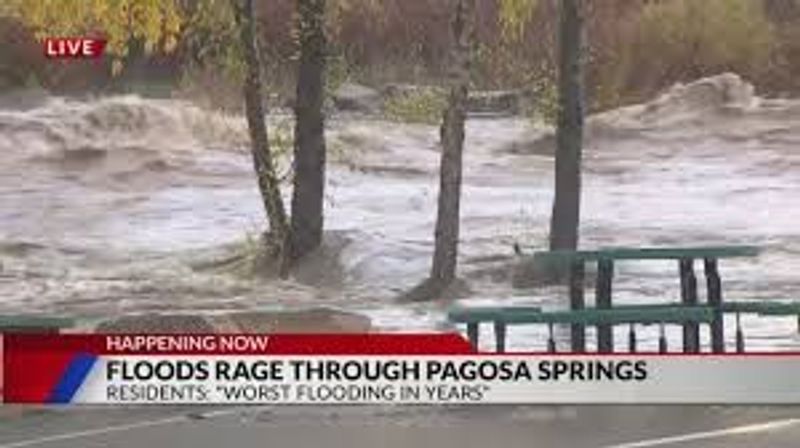
But the full story is more interesting than the sensationalized disaster version.
Pagosa was not washed away.
Downtown did not disappear. Homes in town were not swept downriver. The Springs Resort was not washed away. The community was muddy, busy, and very much on alert — but it was also intact. And when the water dropped, what remained was not just damage. It was a changed river, a few hot springs pools full of mud, a hard-earned reminder of why years of river planning mattered, and a new chance to shape the San Juan corridor into something more resilient, more interesting, and ultimately better than it was before.
The October flood was powerful. Hopefully, it was a once-in-a-lifetime event.
But the river did what rivers naturally do. It wandered. It meandered. It pushed into old and new places. It moved rock. It built gravel bars. It cut banks. It filled pools. It rearranged the channel and created a whole new river experience that boaters, anglers, walkers, families, visitors, and river nerds will be exploring for years.
And because Pagosa Springs had already been investing in the San Juan River before the flood hit, the community was not starting from scratch.
In fact, some of the most important river work in decades was already underway.
The Perfect Storm: Priscilla, Raymond, and a Double Flood in Four Days
The October 2025 flood was not just “a big rain.” It was a rare stack-up of conditions that turned the San Juan River into a force few locals had ever seen in person.
Earlier in the year, the river had been low. Like much of southwest Colorado, Pagosa had been dealing with drought stress and below-average flows. Then late summer and early fall brought a shift. Storms began adding moisture back into the landscape. The ground, riverbanks, drainages, and upper watershed started taking on water.
By the time October arrived, the system was already primed. Then came the tropical moisture. Not one pulse. Two.
The remnants of Tropical Storms Priscilla and Raymond pushed deep moisture into southwest Colorado, creating a one-two punch that produced two historic floods in four days. The San Juan River at Pagosa Springs peaked first at 8,270 cubic feet per second and 12.66 feet at 6 p.m. on Oct. 11, then rose again to 8,570 cfs and 12.82 feet at 5:15 a.m. on Oct. 14. That second peak made the October 2025 flood the third-largest recorded flood at Pagosa Springs, behind only the historic floods of 1911 and 1927.
That second rise is part of what made the event feel so surreal.
This was not one dramatic crest followed by a clean recovery. It was a double surge. The river came up, made its point, dropped enough to let people exhale, then surged again.
By the second round, the watershed was loaded. Soils were saturated. Creeks were running. Hillsides were shedding water. The upper San Juan drainage had no extra room to absorb another wave of tropical moisture.

The first round of precipitation saturated the watershed above Pagosa Springs, meaning additional precipitation primarily flowed straight into the San Juan River. By the second flood peak, the watershed had received 4 to 5 inches of precipitation near Pagosa Springs and 12.5 inches in the mountains feeding the river over the preceding five days. From Oct. 10 through Oct. 14, roughly 1.5 billion cubic feet of water flowed through the San Juan River at Pagosa Springs.
That is the “perfect storm” part of the story.
A dry year had turned into a saturated fall. Tropical moisture arrived in multiple rounds. The upper watershed took a heavy hit. Then the river responded quickly — not over weeks, but over hours.
For those of us watching the river closely, it was mesmerizing, unsettling, and honestly hard to look away from. The San Juan was not just high. It was alive.
What the Flood Really Did
The flood changed the river corridor.
It moved boulders that had not moved in years. It carved new edges into familiar banks. It opened some areas, filled others, stripped vegetation, deposited sediment, moved woody debris, exposed old material, and rearranged features throughout the corridor.

Some of that was damage. Some of it was natural river work. And some of it may end up making the river more interesting.
That is an important distinction, especially for a town like Pagosa Springs, where the San Juan is both a natural system and a heavily loved community space. When a flood moves through, it does not sort its work into neat categories like “bad,” “good,” “habitat,” “recreation,” “infrastructure,” and “aesthetics.” It just moves energy through the valley.
From a community standpoint, Pagosa Springs was fortunate. Very fortunate.
Looking at the scale of water that moved through town, and looking at the damage that could have happened, the town came through better than many headlines suggested. Parks, banks, river access points, trails, utilities, and river features took damage. There was a major cleanup and a serious recovery effort. But the community’s long-term foresight — where development happened, where public space had been created, where river projects had already been planned, and where the river had room to move — helped prevent a much worse outcome.
No one wants to minimize the flood. It was historic. It was powerful. It reshaped the river. But Pagosa was not erased. In some ways, the flood revealed just how much the community had already done right.
The Traveling Cabin: Pagosa’s Most Determined Flood Survivor
Every flood needs at least one story that keeps the whole thing from becoming too heavy. For Pagosa, one of those stories is the cabin.

During the October flood, a small cabin made an unexpected journey downstream and became one of the more memorable pieces of river debris. But this was not the cabin’s first flood rodeo.
Over a century ago, in the historic October 1911 flood, the same cabin had washed downriver and ended up on a property on Hermosa Street where it spent many years. It was moved to a property about two miles upstream from town just a few years ago where it lived a quieter life as a tool shed, collection of western memorabilia and occasional drinking establishment alongside a private pond.
Then came October 2025.
The river rose, the cabin apparently decided it still had unfinished business with the San Juan, and off it went again — this time traveling about a half-mile downstream before parking next to a different pond that had momentarily become a part of the river.
It has since been moved back to the upstream property, but now it is sitting way above the river. Which seems wise.
At this point, that little cabin has seen more of the San Juan River than a lot of locals. It may deserve its own river logbook and a paddle over the mantle, or at least some ground anchors before the next monsoon season.
And honestly, that story captures something about this flood. It was serious, but it was also very Pagosa: dramatic, muddy, surprising, a little funny once everyone was safe, and full of local stories that will be retold for years.
A Long River Story, Not a New One
Pagosa’s relationship with the San Juan River did not begin with the October flood, and it did not begin with the current round of restoration projects. The town has been turning toward the river for decades.

In the late 1980s, after the decline of the local lumber economy, Pagosa Springs began reimagining what the river could mean to the community. The early Riverwalk took shape around 1988, creating one of the first public invitations to walk beside the San Juan rather than simply drive past it. In the 1990s, as the hot springs area developed and downtown began to lean into its riverfront identity, the San Juan slowly shifted from a back-of-town channel to a front-and-center community asset.

Fishing improvements followed. Public overlooks were added. The River Center ponds and habitat areas helped create new places for families, anglers, and wildlife. Later, river access and whitewater features began to appear through town, including a series of in-river improvements built between 2008 and 2018 that helped define Pagosa’s downtown river experience. Cotton’s Hole became another important access and gathering point, tying recreation, land conservation, and public use together in a way that now feels obvious — but took years of vision and persistence to achieve.

That same river-forward mindset later helped make the Mesa Canyon Takeout Project possible in 2021, creating a much-needed downstream access point for one of the San Juan’s most scenic reaches below town. It was another reminder that Pagosa’s river progress has rarely happened through one big move. More often, it has happened one project, one partnership, and one hard-won access improvement at a time.
That long history matters because the October flood did not hit a neglected river corridor. It hit a river corridor that generations of locals had already been improving, piece by piece, for nearly 40 years.
The flood changed the river. But it did not interrupt the story. It became the next chapter.
Gateway: The Project That Proved the Value of River Work Already Underway
The Pagosa Gateway Project may end up being one of the defining examples of why long-term river planning matters.
This project covers roughly two miles of the San Juan River upstream of town. Before the October flood, it was already designed to address a long list of river issues: eroding banks, limited habitat diversity, shallow or disconnected low-water areas, legacy debris like exposed car bodies, impaired riparian vegetation, and boating hazards like a pipeline that had collapsed into the river.
This was never just a beautification project.
It was about making the river function better.
The work included bank stabilization, in-channel habitat improvements, deeper and more connected low-water pools, safer passage for boaters, removal of hazardous debris, native vegetation restoration, and long-term monitoring. And when the October flood arrived, some of the most important parts of that work were already being tested in real time.
The river ran straight through the Gateway reach with historic force. But the bank reinforcement that had already been completed held up well, and the expanded channel capacity that was being developed helped give the river more room to move within the corridor rather than pushing even farther out of the riverbed.
That does not mean the project area was untouched. Far from it.
The flood exposed old problems, moved sediment, reshaped banks, revealed debris, and forced portions of the design and recovery work to adapt to the new river conditions. But it also demonstrated one of the clearest lessons of the entire flood: thoughtful river work matters before disaster strikes, not just after.
One of the most visible examples came from a bank where old car bodies — remnants of past attempts to armor the riverbank with “Detroit riprap” — were exposed by flood erosion. For decades, using junked vehicles as bank stabilization was not uncommon in parts of the West. It may have seemed practical at the time, but modern river restoration has moved far beyond that kind of approach.
The Gateway flood repair work gave the community a powerful before-and-after example: a bank full of exposed car bodies, followed by a quickly rebuilt and stabilized river edge using a more natural, durable, and river-friendly design.


That visual contrast tells the story better than any technical explanation could.
The San Juan River corridor has inherited more than a century of old decisions — some good, some not so good. The current work is helping replace outdated fixes with modern restoration: better bank structure, improved floodplain function, safer passage, cleaner habitat, and a river corridor that works better for people and wildlife.
After the flood, the Gateway Project shifted from a planned restoration project into an active flood recovery effort. The Town of Pagosa Springs, the Upper San Juan Watershed Enhancement Partnership, river engineers, contractors, funders, and local partners adjusted to the new conditions and found a way to keep the work moving. Additional funding through the Natural Resources Conservation Service Emergency Watershed Protection program, paired with Colorado disaster match support, helped cover expanded bank stabilization and recovery needs.
That is the success story.
The flood did not stop the Gateway work. It proved why the work mattered.
It also showed that river restoration is not just about recreation or appearance. Stabilized banks, expanded channel capacity, functioning floodplains, healthy riparian vegetation, thoughtful channel shaping, debris removal, and hazard reduction all matter when the next high-water event comes.
The Gateway reach now stands as a real-world example of adaptive river work. The river changed the plan. The team changed with it. And the result should be a stronger, healthier, more resilient upstream corridor that also creates a better experience for boaters, anglers, landowners, wildlife, and everyone who enjoys the San Juan.
Flood Recovery Work: What Is Already Happening
The post-flood recovery effort is not theoretical. It is happening on the ground, in phases, throughout the river corridor — and the work is moving quickly.
Channel shaping and sediment removal above the Malt Shop to the area above Riff Raff on the Rio has already been completed. That crew has now moved downstream to address the area below the Highway 160 vehicular bridge, through Cotton’s Hole, and above the Veteran’s Pedestrian Bridge. A second crew is also working below Yamaguchi Park.
This is the kind of river work that may not sound glamorous from a distance, but it matters deeply once you understand what the flood left behind. The October high water created cobble bars, sediment deposits, debris piles, filled-in pools, blocked eddies, and altered low-flow paths throughout the corridor. The current work is helping remove excess sediment where it built up, reopen low-flow channels, increase floodplain capacity, and give the river more room to function well at both low and high water.
That matters for flood management.
It matters for fish habitat.
It matters for protecting bridges, banks, utilities, and public infrastructure.
And yes — it matters for recreation, too.
A river with better low-flow channels, cleaner eddies, fewer dangerous debris hazards, and more thoughtfully shaped access points is better for everyone who walks, fishes, floats, paddles, or simply enjoys watching the San Juan move through town.
Southwest River Engineering is also finishing the Overlook Embankment work below Tequila’s and upstream. This project addressed sediment removal in the pools and eddies below the in-river features, along with rock stabilization on the embankment and spurs in the river. That project is anticipated to be complete by mid-May.
Several other major recovery pieces have already been completed by Southwest River Engineering, including phase one of the Museum Embankment Stabilization to secure the lower embankment and the museum’s foundation, debris removal at the Apache Street bridge and along the downtown corridor, and Pagosa Gateway Project embankment stabilization.

Upcoming projects funded through the current recovery package are scheduled to be completed by the end of November 2026. Those include continued sediment removal and channel shaping along the downtown river corridor, Centennial Park Pedestrian Bridge abutment travertine removal, River Center Ponds sediment removal, 6th Street embankment stabilization, and the Pagosa Gateway Project gravel pit conversion to wetland.
In other words, this is not just cleanup.
It is a full river corridor reset.
The flood moved the river dramatically. Now the recovery work is helping guide that new energy into a healthier, more resilient, and more usable San Juan River corridor.
The Funding Story: A Small Town Stretching Dollars in a Big Way
One of the most impressive parts of Pagosa’s current river chapter is not just the amount of work happening — it is how creatively the community has found ways to pay for it.
Flood recovery and river restoration are expensive. Rock work, engineering, bank stabilization, bridge protection, debris removal, pond dredging, revegetation, access improvements, permitting, monitoring, and matching funds all add up quickly.
And yet, Pagosa Springs has already assembled a remarkable funding puzzle.
Between flood recovery, restoration, river access, park improvements, and scheduled river corridor work, the effort now includes support from federal emergency watershed funds, state disaster recovery funds, Colorado Parks and Wildlife, Great Outdoors Colorado, the Land and Water Conservation Fund, Colorado Water Conservation Board programs, History Colorado, the Southwest Community Foundation, local and regional water partners, conservation organizations, tourism partners, and private fundraising.
That is a mouthful — but it is also the point.
This work is not being carried by one agency, one grant, one department, or one group of taxpayers. It is being stitched together from a deep bench of partners who all recognize that the San Juan River is one of Pagosa’s most important public assets.
So far, the approved flood recovery projects total $4.1 million. The majority of that work is being funded through the Natural Resources Conservation Service Emergency Watershed Protection program, which covers 75% of approved project costs. The Colorado Division of Homeland Security and Emergency Management is coordinating another 12.5% match, providing up to $463,504.75 in state disaster support. Town staff is actively pursuing additional grants to help offset the remaining 12.5% local match.
That funding package is helping move a long list of flood recovery projects forward, including the San Juan Historic Museum embankment stabilization, Centennial Park Bridge abutment stabilization, 6th Street embankment stabilization, Overlook riverbank and river-structure work, Gateway-area stabilization, River Center and wetland pond dredging, and major logjam removal along the downtown corridor.
Other funding sources have filled important gaps. Colorado Parks and Wildlife awarded a $103,791 Fishing is Fun Grant for River Center pond sediment removal, headgate replacement, ditch restoration, and outfall repair. History Colorado contributed an emergency $15,000 grant for the San Juan Historic Museum embankment stabilization. The Southwest Community Foundation provided a quick-response $21,000 donation to bring Southwest Conservation Corps crews to town for debris and park cleanup, then helped raise another $21,300 through a flood-relief campaign. The Colorado Water Conservation Board’s Water Supply Reserve Fund added $100,000 toward the 6th Street embankment stabilization and sediment removal at the Donut Hole river feature.
And that is just the flood recovery side.
On the access and park side, the former Bob’s LP property at 1040 E. U.S. Highway 160 was purchased for the East Gateway River Park Project using more than $880,000 in grants from Great Outdoors Colorado and the federal Land and Water Conservation Fund — meaning no local tax money was used for the land acquisition.
Mayor Shari Pierce called that acquisition “the best land purchase that we have made” during her time on council, and it is easy to see why. A once-derelict riverfront property at the east entrance to town is now becoming a public river park, complete with new access, future Riverwalk connection, fishing opportunities, and a stronger first impression for people entering Pagosa from the east.
Federal FEMA disaster assistance was denied, and a proposed no interest CWCB loan was voted down by 130 of the 252 votes in April. Either setback could have slowed the recovery effort considerably.
Instead, Pagosa pivoted.
Town staff and project partners kept pursuing other sources, stacking smaller grants and matches, and moving forward with the work that could be funded. That is part of what makes the current recovery effort so impressive. It is not a story of one giant check solving everything. It is a story of local persistence, creative funding, and a community doing more with less.
The result is a recovery effort that is lean, creative, collaborative, and already visible from the riverbank.
By the Numbers: Pagosa’s River Recovery and Improvement Efforts
-
2 historic flood peaks in four days: Oct. 11 and Oct. 14, 2025
-
8,570 cfs peak flow recorded during the second surge
-
12.82 feet peak river stage on Oct. 14
-
3rd-largest recorded flood at Pagosa Springs, behind 1911 and 1927
-
1.5 billion cubic feet of water flowed through the San Juan River at Pagosa Springs from Oct. 10–14
-
$4.1 million in currently approved flood recovery projects
-
75% of approved project costs covered by NRCS Emergency Watershed Protection funding
-
Up to $463,504.75 in Colorado DHSEM state disaster match funding, covering 12.5% of NRCS-approved project costs.
-
12.5% remaining local match, with Town staff actively pursuing grants to offset that amount
-
$103,791 from Colorado Parks and Wildlife for River Center pond and ditch recovery
-
$100,000 from the CWCB Water Supply Reserve Fund
-
$15,000 from History Colorado for San Juan Historic Museum embankment stabilization
-
$21,000 from the Southwest Community Foundation for Southwest Conservation Corps cleanup support
-
$21,300 raised through the Southwest Community Foundation flood-relief campaign
-
More than $880,000 in grant-funded acquisition money for the East Gateway River Park property
-
$0 local tax dollars used to purchase and improve the former Bob’s LP property
-
At least 8 major confirmed funding streams involved across recovery, restoration, access, and park projects
-
At least $5.7 million+ in confirmed, awarded, approved, donated, or grant-funded river recovery, access, acquisition, and restoration support counted so far
-
3500+ boulders (and counting) delivered by Robins Construction for river corridor work
The People Behind the Work
River projects can look simple once they are finished.
A bank is stabilized. A ramp appears. A trail connects. A pool deepens. A pile of rock becomes a river feature. People walk by later and assume it was always meant to be there.
But none of this happens by accident.
Much of Pagosa’s modern river story has been shaped by people who have spent years — in some cases decades — learning how this river moves, where it can be improved, where it needs room, and how to bring enough partners together to actually get work done.
Kyle Rickert, Project Manager in the Town of Pagosa Springs Development Department, deserves a lot credit in this chapter. Kyle was relatively new in her role when she was thrown straight into the whirlwind of major river projects and historic flood recovery. Since then, she has helped track projects, coordinate updates, pursue grants, manage moving pieces, and keep funding efforts alive across an unusually complex list of recovery needs. Pagosa is lucky to have someone willing to step into that level of chaos and keep pushing the work forward.
James Dickhoff, the Town’s Development Director, has also been central to the modern era of Pagosa river projects. His steady, tireless work has helped manage many of the improvements that now form the backbone of the town’s river corridor vision, from trails and public access to restoration, parks, and long-range planning.
Chris Pitcher of Southwest River Engineering deserves special recognition. A local legend in the river restoration world, Chris has been the mastermind behind most of Pagosa’s river improvements, both historically and in the current recovery era. His work has helped shape the in-river features, bank repairs, access improvements, and restoration projects that define how people experience the San Juan through town.
Robins Construction, working with Southwest River Engineering, has become a major force in the physical rebuilding and reshaping of the river corridor. Their operators are handling the heavy in-river equipment work — moving rock, placing boulders, shaping banks, and helping turn engineering plans into actual river features.
As of this writing, Robins Construction has delivered 3500+ boulders to the Pagosa river corridor.
That number is going to be worth celebrating.
Because each one of those boulders is not just a rock. It is part of a larger system: bank protection, flow direction, fish habitat, channel structure, public access, recreation, and resilience. Efficient, experienced contractors matter because they stretch every dollar further, and in a funding environment where every grant and match counts, that efficiency directly benefits the river.
The river gets the attention, but the progress happening now belongs to the people who know this corridor, work in it, and keep finding ways to move the next piece forward.
East Gateway River Park: A Grant-Funded New River Access Point for Pagosa Springs
One of the most important pieces of Pagosa’s future river corridor is the former Bob’s LP property at 1040 E. U.S. Highway 160.
This 4-acre riverfront site was acquired for the East Gateway River Park Project using more than $880,000 in grants, meaning no local tax money was used for the purchase. The acquisition was funded through state-level Great Outdoors Colorado funding and federal Land and Water Conservation Fund grants.
Mayor Shari Pierce called the Town’s acquisition of the former Bob’s LP property “the best land purchase that we have made” during her time on council.

That is not hard to understand.
For years, this property was not exactly the welcoming eastern gateway Pagosa deserved. Now it is becoming one of the most important public riverfront opportunities in town: a place for new river access, future Riverwalk extension, wetland and park space, parking, fishing access, and a stronger first impression as people enter Pagosa from the east.
A new boat ramp has already been constructed and is being enjoyed by the local boating community. Basic parking improvements have been made, signage is in place, and the project is part of phase one of River Park construction. The May 2025 purchase of the property created an opportunity to expand public river access, lengthen the Riverwalk Trail corridor, provide additional wetland and park space, and establish a unique and defining recreation location for visitors and locals entering town.
This is exactly the kind of project that helps tell the real post-flood story.
Pagosa did not lose its river.
Pagosa is building new ways to reach it.
The new ramp is already changing how local boaters interact with this stretch. As future phases come together, this area has the potential to become a major riverfront asset — not just for floating and boating, but for walking, fishing, gathering, learning, and connecting the east side of town more fully to the San Juan.
It is a new front door to the river.
And it is already open enough for people to start using it.
Yamaguchi South: The Next Big Step Downstream
If Gateway is the upstream restoration anchor and East Gateway River Park is the new eastern access opportunity, Yamaguchi South is one of the most exciting downstream pieces of the puzzle.
The Yamaguchi South River Improvement Project is scheduled to start toward the end of summer 2026, with Southwest River Engineering and Robins Construction at the helm. The project is located at the downstream end of Yamaguchi South Park on South 5th Street, and work will extend from the current river access point downstream to a new public access point near the south property boundary.
This project deserved attention before the flood.
Now it deserves even more.
Yamaguchi South was already designed to improve both recreational and ecological function along the San Juan River. The original goals included enhancing the experience for anglers and river users, improving public access, creating a new public river access at the southern end of Yamaguchi South Park, extending the in-river experience another 1,700 feet, improving fish habitat quality, promoting sediment movement, and upgrading irrigation infrastructure for Yamaguchi Park.
But the October flood changed the scale and urgency of the work.
Downstream of Yamaguchi Park, the river tore into adjacent ranchland, erased a bank lined with mature cottonwoods and alders, and left behind major grading, sediment, and channel-capacity issues that now have to be addressed as part of the larger recovery picture. What had already been planned as a multi-benefit river improvement project is now also part of the community’s flood-recovery strategy: giving the river a better-functioning corridor, improving low-flow channels, increasing floodplain capacity, and reducing the likelihood that future high water simply chews farther into vulnerable banks.

Planned features still include habitat structures, a new boat ramp and parking area, improved river access options, wetland and pond improvements, and channel-shaping structures with riffles and pools. But the post-flood work also adds a more practical layer: significant grading and channel shaping to address cobble bars, sediment deposits, altered banks, and the new river geometry created by the flood.
That is a big deal.
For flood resilience, it means more room for the river to move through a shaped corridor instead of attacking unstable edges.
For anglers, it means better habitat diversity, more interesting water, and improved low-flow conditions.
For boaters and tubers, it means a longer and more dynamic in-town river experience, with cleaner channels and more intentional access.
For the park, it means improved irrigation infrastructure and better integration between the river, wetlands, ponds, and public space.
For wildlife, it means restored riparian areas and wetland improvements where the flood stripped vegetation and reset the banks.
For families, walkers, and everyday park users, it means a richer connection to the water and a more complete river corridor at the south end of town.
The flood delayed and complicated the schedule, but it also made the project more important. This reach now sits at the intersection of recreation, habitat, irrigation, ranchland impacts, sediment management, and floodplain function — exactly the kind of place where thoughtful river work can solve several problems at once.
When Yamaguchi South is complete, it should become one of the most noticeable examples of how Pagosa can combine flood recovery, habitat, recreation, irrigation, ranchland repair, and park function in one thoughtful project.
The 1st Street Pedestrian Bridge: Connectivity, Utilities, and a Cleaner River Corridor
The future 1st Street Pedestrian Bridge is another important piece of the bigger river corridor story.
At first glance, a pedestrian bridge might sound like a trail project. And it is. But in Pagosa, this bridge also ties into flood recovery, utility resilience, downtown connectivity, and the long-term Riverwalk vision.
The bridge will improve pedestrian and bike connectivity between the River Center and Museum side of the river and the growing east-side trail, retail, and recreation corridor. It helps close a gap in the Riverwalk experience and strengthens the idea of a continuous, people-friendly river corridor through town.
It also matters because of what happened during the flood.

Floodwater and debris damaged sewer infrastructure during the October event, and water infrastructure damage was part of the broader flood impact in Pagosa Springs. The future bridge and related utility work now carry even more meaning because they are not only about creating a nicer walk. They are about building a more durable and connected river corridor, raising vulnerable infrastructure out of harm’s way where possible, improving views, improving access, and giving the community a better long-term relationship with the river.
The bridge will be one of those improvements people may eventually take for granted — until they remember what the river looked like in October 2025 and why thoughtful infrastructure matters.
River Center, Fishing Ponds, Parks, and the Everyday River
Not all river recovery is dramatic.
Some of the most important work happens in the places locals use quietly and often: fishing ponds, walking paths, park edges, soft river access, shaded banks, and small sections of trail that connect daily life to the water.
The River Center area, Town Park, Mary Fisher Park, Centennial Park, Cotton Hole, Yamaguchi Park, and the Riverwalk corridor all matter because they are part of the everyday San Juan experience.
These are the places where people walk after dinner, teach kids to fish, sit beside the water, watch spring runoff, take visiting family, or wander down just to see what the river is doing today.
The October flood left debris, sediment, erosion, and cleanup needs across multiple public spaces. But the recovery work has been steady, practical, and community-driven.

The River Center pond work is a good example. It may not make splashy headlines, but sediment removal, headgate replacement, ditch restoration, and outfall repair are the kinds of improvements that keep public fishing areas and river-adjacent park spaces functioning.
This is where the “Pagosa was wiped out” narrative really falls apart.
Yes, the flood was historic.
Yes, there was damage.
But there was also a fast and capable community response. And now, piece by piece, the corridor is being cleaned up, stabilized, replanted, redesigned, and improved.
The river parks are not gone.
They are in transition.
Mesa Canyon: Proof That Community River Projects Work
Downstream from town, the Mesa Canyon Takeout remains one of the clearest examples of what Pagosa’s river community can accomplish when it organizes around a specific need.
For years, the Mesa Canyon stretch had been one of the most scenic and beloved sections of the San Juan River below Pagosa Springs, but the takeout situation was fragile. Boaters needed a reliable, legal, and respectful way to leave the river without creating conflicts with private landowners or damaging sensitive riverbanks. Like many river access issues, the solution was not as simple as pointing to a spot on a map and calling it public.
Completed in 2021 after a community fundraising effort raised more than $90,000 from public and private sources, the Mesa Canyon Takeout Project secured legal public river access, created a safer boat ramp, and expanded parking off the county road at the bottom of that scenic reach. Local boaters, river outfitters, conservation partners, landowners, agencies, and community supporters came together around a practical goal: preserve access, reduce conflict, and make the river experience better without treating the corridor like a free-for-all.

That balance is what made the project important.
Mesa Canyon was not just about building a ramp. It was about proving that recreation access can be handled responsibly when the right people stay at the table. The project respected habitat, private property, road impacts, parking needs, and the reality that people were already using the river and needed a better way to do it.
That same lesson applies directly to the post-flood river corridor through town.
Good river access does not happen by accident. It takes vision, fundraising, engineering, landowner cooperation, public-private partnership, and a shared understanding that recreation, conservation, and responsible management can coexist.
The Mesa Canyon project showed Pagosa what that looks like downstream.
Now that same mindset is helping shape the next generation of river recovery, restoration, and access improvements through town.
The Hidden Value of Recreation in a Flood Recovery Project
After a flood, it is natural for the conversation to shift toward bank stabilization, infrastructure protection, emergency repair, and funding.
That is exactly what should happen first.
But one of the lessons from the San Juan corridor is that recreation, restoration, and flood resilience are not competing goals. When done well, they support each other.
Well-armored banks help keep high water from eating away acres of valuable property. Healthy riparian zones — with willows, cottonwoods, alders, grasses, and deep-rooted native vegetation — can help absorb, slow, and soften flood energy along the edges of the river. A well-engineered channel gives the river more capacity to carry high flows through the corridor without pushing water into places where it causes avoidable damage.
Those same improvements can also make the river better for people.
A good boat ramp keeps users from scrambling down eroding banks. A well-placed access point reduces trespass and helps protect private property. Durable trails keep foot traffic out of sensitive vegetation. Designed river features can improve low-water connectivity, create better fish habitat, and make the river more navigable. Better parking and signage reduce chaos. A healthier riparian corridor improves shade, habitat, bank stability, flood resilience, and the experience of being near the river.
In other words, recreation is not just “fun stuff” added after the serious work is done.
It is part of the serious work.
That is why the current and scheduled projects matter so much. When the funded and planned work is complete, the Pagosa river corridor will be better for recreation, better for fish, better for flood protection, better for public access, and better for long-term river health than it was before the flood.
That does not mean every scar will disappear overnight. Revegetation takes time. Banks need to settle. New features need to be tested by flows. Some places will look raw before they look restored.
But the direction is positive.
Very positive.
What Will Be Better When the Work Is Done
When the current round of funded and scheduled work is complete, the San Juan River corridor through the Pagosa area should be better than it was before the flood in several important ways.
It should be more resilient, with stabilized banks, improved riparian vegetation, repaired embankments, and better-designed river edges.

It should be better for fish, with improved habitat diversity, deeper pools, better low-water connectivity, sediment removal where it is needed, and more thoughtful in-channel structure.
It should be better for boaters and river users, with safer passage, new and improved access points, and a more interesting river channel.
It should be better for parks, with improved integration between public spaces and the river.
It should be better for visitors, who will have more ways to see, walk along, float, fish, and appreciate the San Juan.
It should be better for downtown, with improved connectivity through the Riverwalk corridor and the future 1st Street Pedestrian Bridge.
And it should be better for locals, who get to rediscover a river that has changed in real time.
That last part is worth emphasizing.
A flood does not just damage a river. It creates a new one.
The San Juan now has new textures, new lines, new bars, new eddies, new questions, and new surprises. Some places will be smoother. Some will be pushier. Some will fish differently. Some will float differently. Some will look raw for a while before vegetation returns.
For people who love rivers, that is part of the fascination.
The river is not a museum piece.
It is a living system.
And right now, Pagosa has a rare chance to watch a living river reshape itself while the community actively improves the corridor around it.
A More Honest Post-Flood Story
The sensational version of the flood story is easy to tell.
Historic water. Roads closed. Parks flooded. Emergency response. Damage estimates. Mud. Debris. Dramatic video.
All of that happened.
But that is not the whole story.
The better story is this:
Pagosa Springs experienced a historic flood and came through it with perspective, momentum, and a clearer understanding of how important the San Juan River corridor really is.
The community’s foresight helped prevent a much worse outcome. Years of river planning meant there were already projects, partners, designs, and funding pathways in motion. Existing work was tested, adjusted, and strengthened. New access is already being used. More restoration is scheduled. More habitat work is coming. More recreation improvements are on the way.
The flood was not the end of the river story.
It was a dramatic chapter break.
Come See the New River
For visitors who only saw the headlines, here is the real update:
Pagosa Springs is here.
The river is here.
The Springs Resort had to shovel some muck out of a few hot tubs.
The town is open, active, and moving forward.
And the San Juan River corridor is entering one of the most exciting transformation periods in recent memory.
Yes, the flood changed things. That is what rivers do.
But change is not the same as loss.
The San Juan has a new character now. New bends. New bars. New water. New projects. New access. New recovery work. New stories. New reasons to float or walk down to the river and see what it looks like today.
For our guides it's a once in a lifetime opportunity to learn a whole new hometown river.
For locals, it is a chance to rediscover a familiar place.
For visitors, it is a chance to see a mountain river corridor in motion — not frozen in time, but actively recovering, improving, and becoming more resilient.
Pagosa Springs has spent decades learning how to turn toward the river.
The October flood tested that relationship.
Now the next chapter is underway, and it may be one of the best yet.
The river rose.
Pagosa responded.
And the San Juan River corridor is being rebuilt, reshaped, and reimagined into something stronger than before.
The San Juan River through Pagosa is not a damaged attraction waiting to reopen — it is a living river corridor actively being reshaped, repaired, improved, and reimagined into something better and stronger than before.